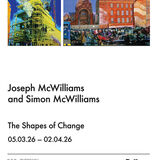
Shapes of Change
University of Ulster, 5th March - 2nd April
Joseph McWilliams (1938–2015) and Simon
McWilliams
Shapes of Change brings together paintings by Joseph McWilliams
and his son Simon McWilliams in an intergenerational exhibition
shaped by painting, shared influences, and family connection
Joseph McWilliams (1938–2015) and Simon
McWilliams
Shapes of Change brings together paintings by Joseph McWilliams
and his son Simon McWilliams in an intergenerational exhibition
shaped by painting, shared influences, and family connection
Living in Belfast has always run like a thread through the work of Joseph and Simon McWilliams, although they often seem to paint very different cities. The opportunity here to see their work in such direct comparison reveals an unexpected, and much closer dialogue between them, one that emphasises individual experience and lives lived within public spaces, that still retain their own sense of privacy.
Joseph McWilliams’ work is closely associated with the fractured Belfast of the Troubles and the post-Troubles years, and he was one of the first artists in Northern Ireland to search for motifs and a manner of working that could convey the shock and uncertainty of that time. Many of his complex and painterly images document a divided city, whose topography was dominated by identity.
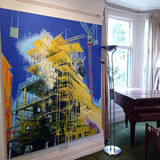
His paintings can seem to occupy a very different place to that of Simon, whose work is more stylised and abstracted than his father’s. His palette is less naturalistic, and in general without the emphasis on figures that is such a feature of Joseph McWilliams’ art, where people create energetic and dynamic narratives within very specific urban spaces. Figures, in Simon McWilliams’ work, establish perspective more than they exist as individuals, and his motifs seem to deny or challenge interpretation. His scaffold-covered buildings, wrapped in vibrant colours, convey the energy of change, of redevelopment away from the troubled times of the city, as if writing the next chapter of this story, although they retain a definite ambiguity.
Beneath this initial divergence between father and son, however, is a shared sense of the city as home, the complex sense of living as an individual within a changing urban environment. Both use paint expressively, evoking a physical response to the places or people they are painting, and creating a surface through which the image reveals itself. It is telling that Joseph McWilliams chose to express the disintegration of a terraced house in Belfast over ten years, through a boxed, multi-media re-creation of its frontal aspect. Material effect is as important for Joseph and Simon, as the replication of an image or an event.
Paint, for both, seems to be an expression of emotion, and a celebration of its intensity. The affirmation of life in his depiction of red chard is a counterpoint to Joseph McWilliam’s elusive and fragmented self-portrait, a flickering and questioning moment that recalls Bonnard’s late self-portraits. In another painting, he includes himself anonymously as part of a bustling scene, a different kind of self-portrait, quietly asserting his individuality within crowds and city streets.
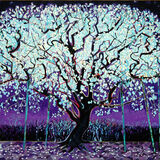
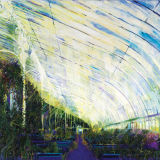
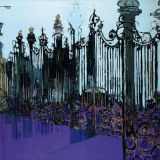
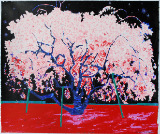
Simon McWilliams seems to choose motifs with great deliberation, often flattening space and working on a scale that forces a sense of unfamiliarity. There is a quiet euphoria about the glow from the Palm House, the scale and colour of a building under construction, or the red flowers outside the window where a cat is sitting, and this expression of a personal and emotional space records a very different experience of life lived within the city.
These are, perhaps, moments of escape rather than engagement, and it is interesting to see this too, in the landscape and seascape by Joseph McWilliams that are also shown here. For an artist associated with the city, it is telling to see him as a landscape painter, creating a tension between the surface and the vast pictorial space of these places, and repeating marks and shapes in a manner reminiscent of Colin Middleton. This aspect of his work recalls the manner in which many artists who lived in Belfast during its late industrial heyday in the early decades of the twentieth century, created the iconography of a rural idyll beyond the city, and rarely painted the urbanisation that they experienced in their daily lives.
Seeing these works by Joseph and Simon McWilliams together, it is easy to forget that they cover more than half a century. Their paintings continue to interrogate Belfast and the act of painting it, and are constantly re-invigorated by the sense of both artist’s excitement in using paint, and in the meanings and weight it can carry.
Dr Dickon Hall, 2026
Joseph McWilliams’ work is closely associated with the fractured Belfast of the Troubles and the post-Troubles years, and he was one of the first artists in Northern Ireland to search for motifs and a manner of working that could convey the shock and uncertainty of that time. Many of his complex and painterly images document a divided city, whose topography was dominated by identity.
His paintings can seem to occupy a very different place to that of Simon, whose work is more stylised and abstracted than his father’s. His palette is less naturalistic, and in general without the emphasis on figures that is such a feature of Joseph McWilliams’ art, where people create energetic and dynamic narratives within very specific urban spaces. Figures, in Simon McWilliams’ work, establish perspective more than they exist as individuals, and his motifs seem to deny or challenge interpretation. His scaffold-covered buildings, wrapped in vibrant colours, convey the energy of change, of redevelopment away from the troubled times of the city, as if writing the next chapter of this story, although they retain a definite ambiguity.
Beneath this initial divergence between father and son, however, is a shared sense of the city as home, the complex sense of living as an individual within a changing urban environment. Both use paint expressively, evoking a physical response to the places or people they are painting, and creating a surface through which the image reveals itself. It is telling that Joseph McWilliams chose to express the disintegration of a terraced house in Belfast over ten years, through a boxed, multi-media re-creation of its frontal aspect. Material effect is as important for Joseph and Simon, as the replication of an image or an event.
Paint, for both, seems to be an expression of emotion, and a celebration of its intensity. The affirmation of life in his depiction of red chard is a counterpoint to Joseph McWilliam’s elusive and fragmented self-portrait, a flickering and questioning moment that recalls Bonnard’s late self-portraits. In another painting, he includes himself anonymously as part of a bustling scene, a different kind of self-portrait, quietly asserting his individuality within crowds and city streets.
Simon McWilliams seems to choose motifs with great deliberation, often flattening space and working on a scale that forces a sense of unfamiliarity. There is a quiet euphoria about the glow from the Palm House, the scale and colour of a building under construction, or the red flowers outside the window where a cat is sitting, and this expression of a personal and emotional space records a very different experience of life lived within the city.
These are, perhaps, moments of escape rather than engagement, and it is interesting to see this too, in the landscape and seascape by Joseph McWilliams that are also shown here. For an artist associated with the city, it is telling to see him as a landscape painter, creating a tension between the surface and the vast pictorial space of these places, and repeating marks and shapes in a manner reminiscent of Colin Middleton. This aspect of his work recalls the manner in which many artists who lived in Belfast during its late industrial heyday in the early decades of the twentieth century, created the iconography of a rural idyll beyond the city, and rarely painted the urbanisation that they experienced in their daily lives.
Seeing these works by Joseph and Simon McWilliams together, it is easy to forget that they cover more than half a century. Their paintings continue to interrogate Belfast and the act of painting it, and are constantly re-invigorated by the sense of both artist’s excitement in using paint, and in the meanings and weight it can carry.
Dr Dickon Hall, 2026